
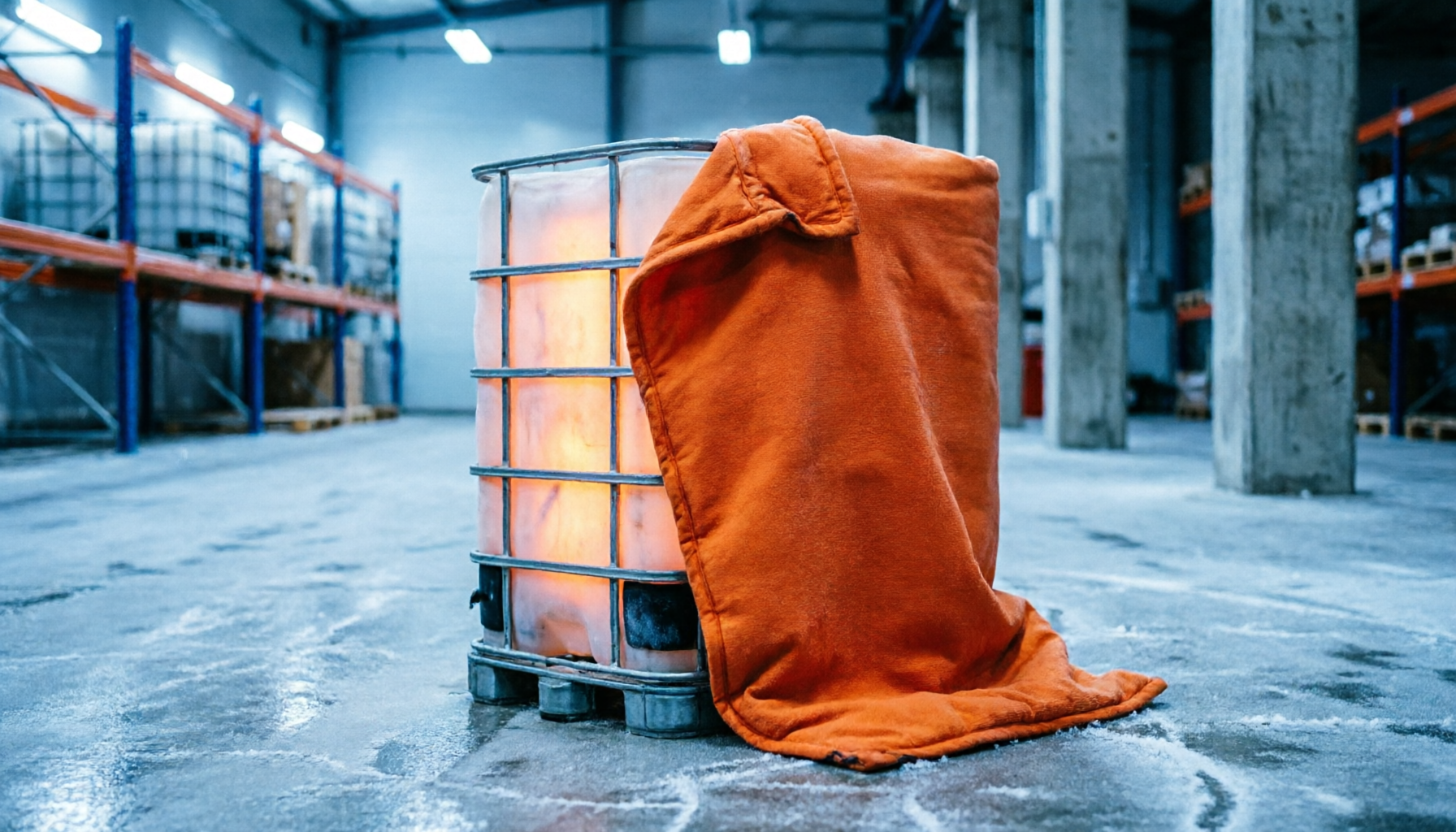
Comparing Heating Pad Options for IBC Totes: Managing High-Pour-Point Oils in Winter
October 8, 2026
Why IBC Heating Matters for High-Pour-Point Oils
When winter temperatures drop below the pour point of edible oils, dispensing from IBC totes becomes slow, inconsistent, or impossible. Palm oil (pour point 30–38°C), palm stearin (pour point 44–56°C), and even some grades of coconut oil solidify well above typical winter warehouse temperatures. Without proper heating, production lines stall, pumps cavitate, and product waste increases.
At HowFun Oil, we supply high-pour-point oils to food manufacturers across temperate climates, and we have tested every major IBC heating method in real winter conditions. This guide compares the four primary heating options and provides selection criteria to help you choose the right solution for your operation.
Understanding Pour Point and Viscosity
Before selecting a heater, it is important to understand two key properties:
- Pour point: The lowest temperature at which the oil will flow under gravity. Below this temperature, the oil becomes semi-solid or solid.
- Viscosity curve: Even above the pour point, viscosity increases exponentially as temperature drops. An oil that pours freely at 40°C may be 10 times more viscous at 20°C.
| Oil Type | Typical Pour Point | Recommended Dispensing Temp |
|---|---|---|
| Palm olein | 10–15°C | 25–30°C |
| Refined palm oil | 30–38°C | 40–50°C |
| Palm stearin | 44–56°C | 55–65°C |
| Coconut oil | 22–25°C | 30–40°C |
| Sunflower oil | -15 to -10°C | 15–20°C (usually no heating needed) |
| Soybean oil | -18 to -12°C | 15–20°C (usually no heating needed) |
Option 1: Full-Wrap Heating Blankets
Full-wrap heating blankets encase the entire IBC tote in an insulated, electrically heated jacket. They are the most comprehensive solution for high-pour-point oils because they heat the oil uniformly from all sides.
How They Work
Silicone or fiberglass heating elements are embedded between an inner food-contact layer and an outer insulated shell. The blanket wraps around the IBC and is secured with straps or hook-and-loop fasteners. A built-in thermostat maintains the target temperature within ±2°C.
Advantages
- Uniform heating across all surfaces prevents cold spots and localized overheating.
- Insulation layer reduces energy consumption by 40–60% compared to uninsulated heaters.
- Digital thermostat allows precise temperature control for sensitive oils.
- Can maintain temperature indefinitely, ideal for long-term winter storage.
Limitations
- Highest upfront cost among IBC heating options (typically $400–$800 per unit).
- Requires a dedicated electrical circuit (1,000–2,000W per blanket).
- Bulkier to store when not in use.
Option 2: IBC Base Heaters
Base heaters are flat, electrically heated platforms that the IBC tote sits on. They heat the oil from the bottom up, relying on natural convection to distribute warmth through the tote.
How They Work
A steel or aluminum heating plate sits on the floor, and the IBC is placed on top. The plate heats the bottom layer of oil, which rises and creates a convection current that gradually warms the entire volume.
Advantages
- Lower cost than full-wrap blankets ($200–$400 per unit).
- Simple to install—just place the IBC on the platform.
- Easy to store and move between IBCs.
Limitations
- Slow heating—may take 24–48 hours to bring a full 1,000L IBC to temperature.
- Temperature gradient: oil at the top may remain solid while the bottom is liquid.
- Not suitable for very high pour point oils like palm stearin in cold environments.
- Less energy-efficient because heat escapes from the uninsulated sides and top.
Option 3: Immersion Heaters
Immersion heaters are electric heating rods inserted through the IBC top opening directly into the oil. They provide the fastest heating but require more hands-on management.
How They Work
A stainless steel heating element (typically 1,000–3,000W) is lowered into the IBC through the 150mm or 225mm top cap. The element heats the surrounding oil directly, and a built-in thermostat or external controller regulates the temperature.
Advantages
- Fastest heating rate—can bring 1,000L to dispensing temperature in 4–8 hours.
- Portable and can be moved between IBCs.
- Effective for spot-heating when only partial discharge is needed.
Limitations
- Risk of localized overheating if the element is too powerful or left unattended.
- Requires opening the IBC, which introduces contamination risk if not managed properly.
- Not suitable for continuous long-term storage heating.
- Must be removed before the IBC is moved or stacked.
Option 4: Insulated Jackets (Passive)
Insulated jackets contain no heating element. They rely on thermal mass and insulation to slow heat loss from oil that was pre-heated before filling.
How They Work
A thick layer of closed-cell foam or reflective insulation wraps around the IBC. If the oil is filled at the correct temperature, the jacket slows cooling enough to maintain dispensing viscosity for 24–72 hours depending on ambient conditions.
Advantages
- Lowest cost ($50–$150 per jacket).
- No electricity required—safe for any environment.
- Lightweight and easy to store.
Limitations
- Cannot raise oil temperature—only slows cooling.
- Ineffective for multi-day storage in cold conditions.
- Must be combined with a pre-heating step (e.g., warm room or immersion heater).
Comparison Summary
| Feature | Full-Wrap Blanket | Base Heater | Immersion Heater | Insulated Jacket |
|---|---|---|---|---|
| Heating speed | 12–24 hours | 24–48 hours | 4–8 hours | N/A (passive only) |
| Temperature uniformity | Excellent | Poor (gradient) | Moderate | N/A |
| Energy efficiency | High | Low | Moderate | N/A |
| Cost range | $400–$800 | $200–$400 | $150–$500 | $50–$150 |
| Best for | Long-term winter storage | Mild climates, low pour point | Quick turnaround | Short-term transport |
| Suitable for palm stearin | Yes | No | Yes (with care) | No |
Selection Criteria for Your Operation
Choose your IBC heating solution based on these factors:
- Oil pour point: Oils above 35°C pour point (palm oil, palm stearin) need full-wrap blankets or immersion heaters. Lower pour point oils can use base heaters.
- Throughput volume: High-throughput operations that cycle through IBCs daily benefit from immersion heaters for speed. Operations with longer storage periods should invest in full-wrap blankets.
- Ambient temperature: In unheated warehouses below 10°C, base heaters alone are insufficient for high-pour-point oils.
- Food safety requirements: If your quality protocols require sealed containers, avoid immersion heaters that require opening the IBC.
- Budget: A combination approach—insulated jackets for transport plus full-wrap blankets for storage—often provides the best value.
Winter Operation Best Practices
- Pre-heat before filling: If possible, store IBCs in a heated area (15–20°C) for 24 hours before filling with warm oil. This reduces the thermal shock and extends the time before re-heating is needed.
- Monitor with data loggers: Place a temperature data logger inside each IBC to track the oil temperature throughout storage and transport.
- Use thermostatic controls: Never rely on manual on/off switching. All electric heaters should have automatic thermostat control to prevent overheating, which can degrade oil quality.
- Plan for power outages: In regions with unreliable power, have insulated jackets as backup to maintain temperature during outages.
- Label clearly: Mark each IBC with the oil type, pour point, and required dispensing temperature so operators know the heating requirements.
- Coordinate with your supplier: Work with your bulk oil supplier to ensure the oil arrives at a temperature that minimizes your re-heating burden.
Conclusion
Managing high-pour-point oils in IBC totes during winter requires a deliberate heating strategy. Full-wrap heating blankets offer the best combination of uniformity, efficiency, and reliability for the most demanding applications. Base heaters and insulated jackets serve as cost-effective supplements for milder conditions or short-term needs. Immersion heaters fill the niche of rapid turnaround when speed is the priority.
For guidance on selecting the right packaging and heating approach for your specific oil type and climate, contact us at HowFun Oil. Our technical team can recommend optimal storage and dispensing solutions based on your production requirements and destination conditions.
Custom Packaging Solutions
From 100ml retail bottles to 200L foodservice pails, we offer complete packaging solutions with custom branding and label design.
Premium Walnut Oil
Cold-pressed walnut oil rich in omega-3 fatty acids. Ideal for salad dressings, finishing oils, and specialty health food markets.
View Walnut Oil Products →Explore Our Products
Browse our full range of bulk edible oils for importers, distributors, and food manufacturers.
Need Custom Packaging or Private Label?
We offer full OEM/ODM services including custom formulation, private label branding, and flexible packaging starting from 6,000 bottles.
Explore Custom Services →See How We Help Our Clients
From restaurant chains to international distributors, discover how our edible oil solutions drive business growth for partners worldwide.
View Case Studies →Get a Quote
Fill out the form below and we'll get back to you within 24 hours