
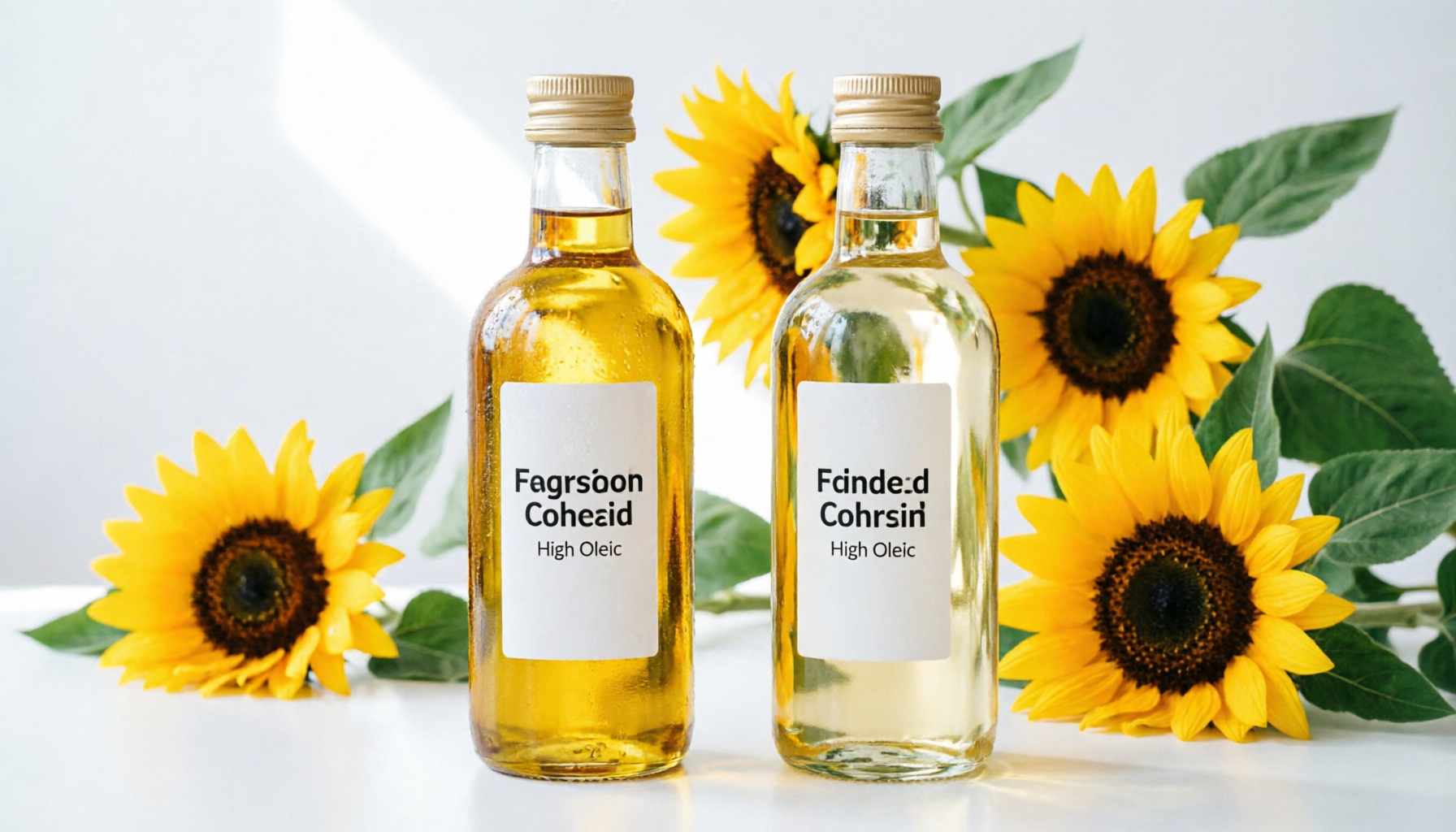
High-Oleic vs Conventional Sunflower Oil: Performance, Cost & Frying Life Comparison for B2B Buyers
September 29, 2026
Understanding Sunflower Oil Types
Sunflower oil is one of the most widely used vegetable oils in commercial food production. However, not all sunflower oil is created equal. The two main types available to B2B buyers are high-oleic sunflower oil and conventional (linoleic) sunflower oil. The key difference lies in their fatty acid composition, which directly affects frying performance, oxidative stability, shelf life, and ultimately, your cost per kilogram of finished product.
Choosing the right type of sunflower oil can significantly impact your production efficiency, product quality, and bottom line. This guide breaks down the technical differences and practical implications for food manufacturers, fryers, and B2B buyers.
Fatty Acid Composition: The Core Difference
| Fatty Acid | High-Oleic Sunflower Oil | Conventional Sunflower Oil |
|---|---|---|
| Oleic Acid (C18:1, monounsaturated) | ≥ 80% | 14-39% |
| Linoleic Acid (C18:2, polyunsaturated) | 3-10% | 48-74% |
| Palmitic Acid (C16:0, saturated) | 3-5% | 5-8% |
| Stearic Acid (C18:0, saturated) | 2-5% | 3-6% |
The high oleic acid content in high-oleic sunflower oil is the primary driver of its superior oxidative stability. Monounsaturated fats are far more resistant to oxidation than polyunsaturated fats, which means the oil lasts longer under heat stress.
Oxidative Stability and Frying Performance
Oxidative Stability Index (OSI)
The Oxidative Stability Index measures how long an oil resists oxidation at elevated temperatures. Higher OSI values indicate longer fry life and better oil endurance.
| Parameter | High-Oleic Sunflower Oil | Conventional Sunflower Oil |
|---|---|---|
| OSI at 110°C | 20-30 hours | 3-6 hours |
| Smoke Point | 230-240°C (446-464°F) | 225-230°C (437-446°F) |
| Typical Fry Life | 2-3x longer | Standard |
| Polymer Formation | Low | Moderate to high |
| Foaming Tendency | Low | Moderate |
What This Means in Practice
- High-oleic oil can maintain frying quality for 40-80+ hours of continuous frying, depending on the food being fried and fryer management practices.
- Conventional oil typically requires replacement or significant topping up after 15-30 hours of frying.
- High-oleic oil produces less polymer buildup on fryer surfaces, reducing cleaning time and maintenance costs.
- Food fried in high-oleic oil tends to have a cleaner taste, less greasy mouthfeel, and longer shelf life.
Cost Analysis: Price vs. Total Cost of Ownership
At first glance, high-oleic sunflower oil is more expensive than conventional sunflower oil. However, the total cost of ownership tells a different story for many operations.
Price Comparison
| Factor | High-Oleic Sunflower Oil | Conventional Sunflower Oil |
|---|---|---|
| Base Price (per MT) | 15-30% premium | Standard market price |
| Oil Change Frequency | Every 40-80 hours | Every 15-30 hours |
| Oil Consumption Rate | Lower (less absorption) | Higher |
| Waste Disposal Cost | Lower volume | Higher volume |
| Product Shelf Life | Extended | Standard |
When High-Oleic Saves Money
- High-volume frying operations: Snack food manufacturers, fast-food chains, and frozen food producers benefit most from the extended fry life.
- Products requiring long shelf life: Packaged snacks, ready meals, and export products benefit from the superior oxidative stability.
- Operations with high labor costs: Fewer oil changes mean less downtime and lower labor costs.
When Conventional Makes Sense
- Low-volume or intermittent frying: Restaurants or small producers that fry infrequently may not justify the premium.
- Products with short shelf life: Fresh-prepared foods consumed within days do not need extended oil stability.
- Price-sensitive markets: Where the end product margin cannot absorb the oil premium.
Impact on Finished Product Quality
| Quality Factor | High-Oleic Sunflower Oil | Conventional Sunflower Oil |
|---|---|---|
| Flavor Stability | Excellent — minimal off-flavors | Moderate — may develop rancid notes |
| Texture | Crisp, light, non-greasy | Can become heavy or oily over time |
| Color Retention | Oil stays lighter longer | Darkens faster with use |
| Shelf Life of Fried Product | Extended (less rancidity) | Standard |
| Acrylamide Formation | Lower tendency | Higher tendency with oil degradation |
Regulatory and Labeling Considerations
Both types of sunflower oil are generally recognized as safe (GRAS) and comply with international food safety standards. However, there are labeling differences to consider:
- High-oleic sunflower oil can be labeled as a source of monounsaturated fat, which is attractive for health-conscious consumers and may support heart-health claims in certain markets.
- Conventional sunflower oil is rich in polyunsaturated fat (linoleic acid, an essential omega-6 fatty acid), which also supports certain nutritional claims.
- In the EU and US, both types must be declared as "sunflower oil" on ingredient lists, but the specific fatty acid profile can be highlighted in marketing materials.
Storage and Handling Best Practices
Regardless of which type you choose, proper storage and handling are essential to maximize oil performance:
- Store in a cool, dark place: Ideal temperature 15-25°C (59-77°F)
- Minimize air exposure: Keep containers sealed; use nitrogen blanketing for bulk storage
- Avoid water contamination: Even trace moisture accelerates hydrolysis
- Filter regularly: Remove food particles to extend fry life
- Monitor oil quality: Use FFA test strips or meters to track degradation
- Rotate stock: Use FIFO (first in, first out) inventory management
How to Choose: A Decision Framework
| Your Priority | Recommended Type |
|---|---|
| Maximum fry life and oil endurance | High-Oleic |
| Lowest upfront cost | Conventional |
| Best product shelf life | High-Oleic |
| Clean-label / health positioning | High-Oleic (monounsaturated fat claim) |
| Intermittent, low-volume frying | Conventional |
| High-volume continuous frying | High-Oleic |
| Minimal oil flavor transfer | High-Oleic |
Source Quality Sunflower Oil from HowFun Oil
HowFun Oil supplies both high-oleic and conventional sunflower oil for B2B buyers worldwide. Our oils are produced under strict quality control with full certification (ISO 22000, HACCP, Halal, Kosher) and third-party lab testing. We offer flexible packaging from flexitanks to retail-ready bottles, including private-label options. Contact us for a customized quote tailored to your production needs.
Looking for Bulk Sunflower Oil?
Explore our refined and crude sunflower oil options, available in flexitank, IBC drum, and retail packaging. ISO 22000 certified with full export documentation.
Our Quality Control Standards
ISO 22000 and HACCP certified facility with full COA, SGS testing, and export documentation. Every batch is tested before shipment.
View Quality Control Details →Explore Our Products
Browse our full range of bulk edible oils for importers, distributors, and food manufacturers.
Need Custom Packaging or Private Label?
We offer full OEM/ODM services including custom formulation, private label branding, and flexible packaging starting from 6,000 bottles.
Explore Custom Services →See How We Help Our Clients
From restaurant chains to international distributors, discover how our edible oil solutions drive business growth for partners worldwide.
View Case Studies →Get a Quote
Fill out the form below and we'll get back to you within 24 hours