
How to Verify a Chinese Edible Oil Manufacturer Before Placing Your First Order
August 6, 2026
How to Verify a Chinese Edible Oil Manufacturer Before Placing Your First Order
For many food distributors and importers, the decision to source edible oil from China represents a significant opportunity — but also a real risk.
China is one of the world's largest producers of vegetable oils, with competitive pricing, mature manufacturing infrastructure, and a wide range of product options. However, not every supplier listed online is a legitimate manufacturer. Some are trading companies that have never set foot in a production facility. Others may hold expired or falsified certifications. A few may not even exist as registered businesses.
If you are about to place your first order with a Chinese edible oil supplier, this guide walks you through five practical verification steps that will help you separate reliable manufacturers from risky suppliers — before you commit any money.
Step 1: Verify the Company's Legal Registration and Export Qualifications
Every legitimate Chinese food export company must be registered with Chinese authorities and hold specific qualifications.
What to Request
Ask your supplier for:
Business License (营业执照) — confirms the company is legally registered. Check the registered capital, business scope (should include "food production" or "food sales"), and establishment date.
Export Filing for Food (食品出口备案) — a mandatory registration with China's customs authority for any company exporting food products.
Customs Registration Code (海关编码) — a 10-digit code that confirms the company is registered for import/export trade.
How to Verify
You can cross-check a company's registration through:
National Enterprise Credit Information Publicity System (国家企业信用信息公示系统) — search the company's Chinese name to view their registration status, business scope, and any administrative penalties.
China Customs filing database — your freight forwarder can help verify whether the company has a valid customs registration code.
If a supplier cannot provide these documents or becomes evasive when asked, this is a serious red flag.
Step 2: Confirm That Food Safety Certifications Are Genuine and Current
Certifications are one of the fastest ways to assess a supplier's quality standards — but only if they are authentic.
Common Certifications for Chinese Edible Oil Exporters
Certification | What It Covers | Issuing Body |
ISO 22000 | Food Safety Management System | ISO-accredited certifiers (e.g., SGS, BV, TÜV) |
HACCP | Hazard Analysis and Critical Control Points | ISO-accredited certifiers |
BRCGS | Global Food Safety Standard (widely required by European retailers) | BRCGS-licensed certifiers |
IFS | International Featured Standard (common in European retail) | IFS-licensed certifiers |
Halal | Halal compliance | Recognized Halal certification bodies |
Kosher | Kosher compliance | Recognized Kashrut organizations |
How to Verify Certificate Authenticity
Every legitimate certificate includes:
Certificate number — can be verified on the certifying body's website (SGS, Bureau Veritas, TÜV, etc.)
Company name — must match the supplier's registered name exactly
Scope of certification — must include the specific product category (e.g., "refined vegetable oil production")
Validity period — expired certificates are a common issue. Always check the expiration date.
Tip: Some suppliers display certification logos on their website without actually holding the certificate. Always request the certificate document with the certificate number, and verify it directly with the issuing body.
Step 3: Request Product Samples and a Certificate of Analysis (COA)
Before placing a bulk order, always — without exception — request:
A physical product sample shipped to your address
A Certificate of Analysis (COA) for the specific batch the sample is drawn from
What a Professional COA Should Include
A genuine COA from a real manufacturer should contain:
Product name and grade (e.g., "Refined Soybean Oil, Food Grade")
Batch number — traceable to a production run
Production date and testing date
Key quality parameters:
Free Fatty Acid (FFA): typically ≤ 0.1% for refined oils
Peroxide Value (PV): typically ≤ 5.0 meq/kg
Moisture and Impurities: typically ≤ 0.05%
Color value (e.g., Lovibond)
Iodine value (where applicable)
Testing method reference (e.g., AOCS, ISO, or GB standards)
Signature or stamp of the quality lab technician
Red Flag: "We Don't Provide COA"
If a supplier says they cannot provide a COA, or sends a generic specification sheet without batch-specific data, walk away. Any real food production facility conducts batch testing as part of their quality control process.
What to Do with the Sample
When you receive the sample:
Compare it against the COA parameters
Conduct your own sensory evaluation (color, clarity, odor, taste)
If you have access to a lab, verify key parameters independently
Confirm the sample matches what you will receive in bulk — including packaging compatibility
Step 4: Conduct a Virtual Factory Audit
Not every buyer can travel to China for an in-person factory visit. However, any legitimate manufacturer should be able to accommodate a virtual audit via video call.
How to Request a Virtual Audit
A simple message works:
"Before we proceed with our first order, we would like to schedule a 30-minute video call to see your production facility. Can we arrange this via WhatsApp, WeChat, or Zoom?"
What to Ask to See During the Call
A genuine manufacturer should be able to show you, in real time:
Raw material storage area — where incoming raw materials are inspected and stored before production
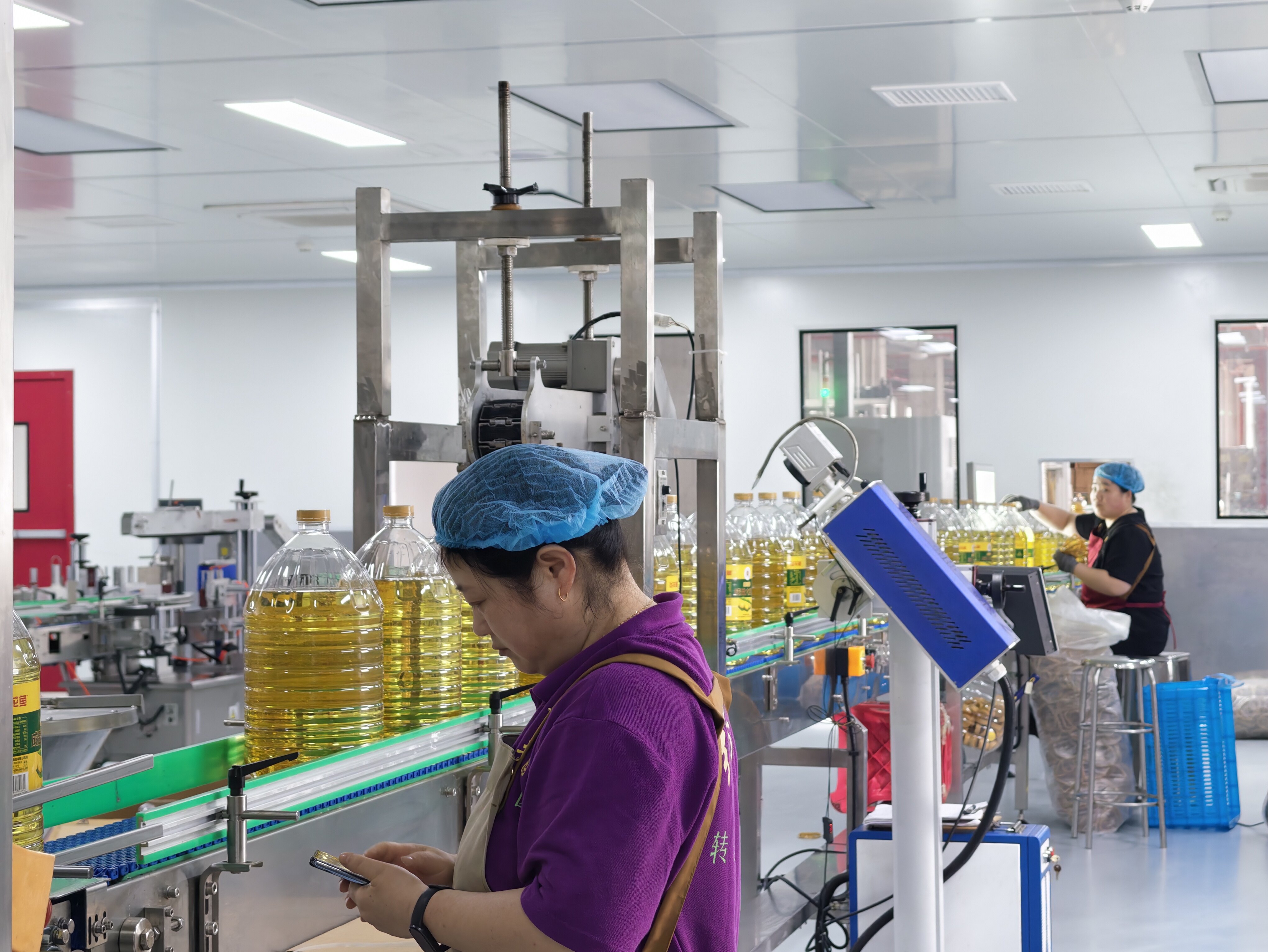
Production line — the actual refining or pressing equipment, ideally running
Quality control laboratory — testing equipment such as titration apparatus, spectrophotometers, or gas chromatography setups
Filling and packaging line — where finished oil is bottled, sealed, and labeled
Finished goods warehouse — where packaged products are stored before shipment
What a Virtual Audit Reveals
What You See | What It Means |
Clean, organized production area with clear hygiene protocols | Real manufacturing operation |
Equipment with visible brand names and model numbers | Can be cross-referenced for authenticity |
Batch records, production logs, or quality test results on display | Active quality management system |
Staff wearing proper food safety gear (hairnets, gloves, uniforms) | Food-grade production environment |
Red Flag: "We Can't Do Video, Here Are Some Photos"
Photos can be downloaded from the internet or borrowed from another factory. A live video call is significantly harder to fake. If a supplier repeatedly refuses a video call or keeps rescheduling, this is a strong warning sign.
Step 5: Start with a Trial Order Before Scaling Up
Even if everything checks out in Steps 1–4, the safest approach for a first-time buyer is to begin with a trial order — a smaller quantity than your typical purchase — to validate the supplier's actual performance under real conditions.
What a Trial Order Should Include
Quantity: Small enough to limit financial risk, but large enough to be meaningful (e.g., one container of 210L drums, or a partial-container shipment)
Full documentation: COA, Certificate of Origin, Health Certificate, Phytosanitary Certificate
Clear quality specifications: Agreed in writing before production begins
Third-party inspection (optional): SGS, Bureau Veritas, or Intertek can inspect the shipment before loading
What to Evaluate After the Trial
Evaluation Criteria | What to Check |
Communication quality | Were responses timely? Were questions answered clearly? |
Production lead time | Did the shipment leave on the agreed schedule? |
Product quality on arrival | Does the oil match the sample and COA? |
Documentation accuracy | Were all export documents correct and complete? |
Packaging condition | Did the packaging survive shipping without damage or leakage? |
After-sales support | How did the supplier handle any issues that arose? |
If the trial order meets your expectations, you can proceed with confidence to larger orders and a longer-term partnership.
Common Red Flags When Evaluating Chinese Edible Oil Suppliers
Based on common patterns in the industry, here are warning signs that should cause you to pause:
Pricing significantly below market average. If one supplier's price is 20–30% lower than others for the same product and quantity, something is wrong — either the quality is compromised, the product doesn't exist, or the quote is bait.
Reluctance to provide COA or samples. A genuine manufacturer treats quality documentation as a standard part of doing business.
Inability to conduct a live video call. This is the single most effective way to distinguish a real factory from a trading company pretending to be one.
Certifications that cannot be verified. If the certificate number doesn't check out on the issuing body's website, or the company name doesn't match, the document is not valid.
Pressure to pay quickly or in unusual ways. Legitimate export transactions typically use standard payment methods (T/T, L/C) with standard terms. Requests for payment to personal accounts, cryptocurrency, or unusual urgency should be treated with caution.
How HOWFUN OIL Supports Buyer Verification
At HOWFUN OIL, we understand that trust must be earned — especially when working with a new international partner for the first time.
That is why we welcome buyers to:
Review our ISO 22000, HACCP, and food safety certifications — and verify them with the issuing bodies
Request product samples and batch-specific COAs before placing any order
Schedule a virtual factory tour to see our production lines, quality lab, and warehouse in real time
Start with a trial order to validate our quality and service before scaling up
We believe that a transparent, verifiable supply chain is the foundation of a successful long-term partnership.
Conclusion
Verifying a Chinese edible oil manufacturer does not require special expertise — it requires asking the right questions and being willing to walk away when the answers don't add up.
By checking legal registration, verifying certifications, requesting samples and COAs, conducting a virtual audit, and starting with a trial order, you can significantly reduce the risk of your first international edible oil purchase.
A reliable supplier will welcome this level of scrutiny. If a supplier resists verification, that resistance itself is your answer.
Planning your first edible oil import from China? Contact HOWFUN OIL to request product specifications, COAs, certifications, or to schedule a virtual factory tour. We are ready to be verified.
Explore Our Products
Browse our full range of bulk edible oils for importers, distributors, and food manufacturers.
Need Custom Packaging or Private Label?
We offer full OEM/ODM services including custom formulation, private label branding, and flexible packaging starting from 500 bottles.
Explore Custom Services →See How We Help Our Clients
From restaurant chains to international distributors, discover how our edible oil solutions drive business growth for partners worldwide.
View Case Studies →Get a Quote
Fill out the form below and we'll get back to you within 24 hours